
Hiro's Final Flame
PURPOSE· 9 MIN READ
The Light Above the Strait
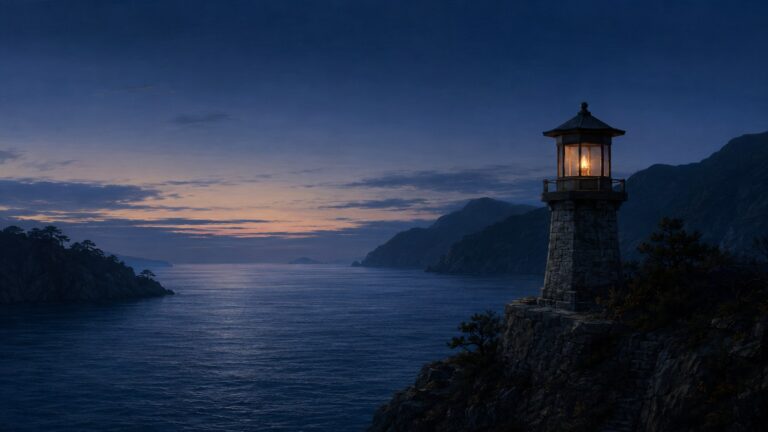
On a small island off the coast of Japan, a stone tower stood above a narrow strait. During the day, fishing boats moved safely between the island and the mainland. After sunset, however, the channel became treacherous. Black rocks waited beneath the surface, while strong currents drew unfamiliar vessels toward the cliffs.
For forty years, an old man named Hiro had tended the beacon at the top of the tower. Before darkness settled over the water each evening, he climbed the winding stairs with a small container of oil. At the top, he cleaned the glass, cleared the air vents, trimmed the wick, and lit the flame.
The light was not large. From the village below, it looked no brighter than a single star resting upon the cliff.
Hiro’s grandson, Ren, often accompanied him. Clever and restless, Ren longed to do something important with his life. He dreamed of studying engineering in the city, where buildings climbed into the clouds and electric lights turned midnight into day.
A Life Too Small to Notice
One evening, while Hiro polished the beacon’s glass, Ren studied the small flame.
“Does anyone still need this?” he asked.
“Fishermen continue to sail at night.”
“Their boats have instruments now,” Ren replied. “The mainland harbor has electric signals. This lamp is old.”
Hiro glanced at him. “So am I, yet you still bring me supper.”
Ren laughed. “That is different.”
“Most things appear different until we understand what they have in common.”
As Hiro adjusted the wick, Ren leaned against the stone wall.
“I want to build something people will notice,” he said. “Something large enough to matter.”
His grandfather looked through the glass toward the darkening sea. “The flame does not ask whether anyone notices it.”
“Then how does it know it matters?”
“It does not need to know.”
Every night, Hiro repeated the same quiet ritual. No crowd gathered when the beacon appeared. No bell announced that the work was finished. Because the light had always been there, most villagers had stopped looking toward the tower at all.
To Ren, his grandfather’s life seemed painfully small – a collection of ordinary tasks performed for people who rarely noticed and never applauded.
The Night That Asked for Attention
One autumn afternoon, Hiro became ill. A fever left him too weak to rise from bed. As the sun began to sink, he called Ren to his side.
“You must light the beacon tonight.”
Ren looked through the window. The sky was clear, and the sea appeared calm. “Only for tonight?”
“Tonight is the only night asking for your attention.”
Taking the oil, Ren climbed the tower alone. He cleaned the glass as he had watched his grandfather do. Next, he trimmed the wick, though he worried that he had cut it too short. When the flame flickered weakly, he adjusted it until the light burned steadily. Then he returned to the village.
At first, nothing happened. Families ate their evening meals, children chased one another between the houses, and fishermen repaired nets beneath hanging lanterns. No one thanked Ren. No horn sounded from the water. High above them, the small flame simply burned.
By morning, Hiro’s fever had not broken.
“You must light it again,” he said.
Ren sighed. “Grandfather, the weather is fine.”
“The weather here is fine.”
“What does that mean?”
Closing his eyes, Hiro answered, “The sea is larger than the view from our window.”
A Storm Beyond the Window
That evening, clouds gathered beyond the mainland, although the air around the island remained still. Ren lit the beacon and watched until the flame settled into an even glow.
While descending the tower, he imagined his friends in the city studying machines, designing bridges, and preparing to shape the future. Meanwhile, he was trimming an old wick for sailors who might never glance toward it.
A sudden gust struck the tower. Before Ren reached the village, rain had begun.
The storm arrived with startling force. Waves crashed against the harbor wall as families fastened their shutters. Fishermen dragged smaller boats higher onto the shore, and lightning revealed the sea in brief white flashes.
The Darkened Beacon
Then Ren remembered the narrow air vents beneath the lamp. Hiro cleared them every night, but Ren had forgotten. If smoke gathered inside the chamber, the flame could die.
He turned toward the cliff. The beacon was dark.
With a lantern in hand, Ren ran through the rain. Wind fought him along the path and nearly tore the tower door from his grasp. Once inside, he forced it shut and hurried up the spiraling stairs.
Smoke hung in the beacon chamber. Ren cleared the blocked vents, trimmed the blackened wick, and struck a match. The first flame failed. His second attempt caught, shivered beneath the glass, and finally steadied.
Beyond the tower, another light appeared upon the water. It vanished between the waves, then returned. A boat was approaching the strait.
Pressing close to the glass, Ren saw that the vessel was too far north. The current was carrying it toward the submerged rocks. He opened the tower’s outer shutter and allowed the full beam to sweep across the water.
Still, the boat continued toward the island. For several terrible moments, he feared its crew had missed the warning. At last, the bow turned. Slowly, the vessel moved away from the rocks and entered the safe channel. It passed beneath the cliff, rising and falling upon the waves, before disappearing toward the protected harbor.
Ren remained beside the flame until dawn.
What the Light Had Done
When Ren returned home, Hiro was awake.
“A boat came through the storm,” Ren said. “It nearly struck the rocks.”
His grandfather nodded. “But it did not.”
“I relit the beacon just in time.”
Hiro studied his grandson’s face. “You sound surprised.”
“I did not know anyone was depending on it.”
“You did not see anyone depending on it,” Hiro corrected gently.
Ren sat beside the bed. “If I had decided the work was too small…”
“But you climbed the tower.”
“Only because you told me to.”
A faint smile touched Hiro’s face. “Many worthy things begin as duties we do not yet understand. Purpose often reveals itself after we have chosen to be faithful.”
The One Searching in the Dark
Several days later, the boat’s captain came to the village. His vessel had been carrying medicine and supplies to an island farther north when the storm damaged its navigation instruments.
“I searched the darkness for the old beacon,” the captain explained. “I knew that if I could find Hiro’s light, I could find the channel.”
Ren looked toward his grandfather. “You knew it would be there?”
“It has always been there,” the captain replied.
Hiro smiled, but said nothing.
The captain never learned that the flame had gone out. He did not know about the blocked vents, Ren’s race through the storm, or the trembling hands that had relit the wick.
He knew only that when darkness closed around him, the light appeared where he trusted it would be.
Lessons Carried to the City
The following spring, Ren left the island to study engineering. In time, he helped design bridges, seawalls, and tall buildings filled with thousands of electric lights. His name appeared on drawings and brass plaques, and people admired what he built.
Even so, the lesson of the beacon traveled with him.
Ren discovered that the strongest bridge depended upon bolts no traveler would ever notice. A great building remained standing because workers had measured, checked, and secured ordinary things hidden behind its walls. Public safety often rested upon someone tending one small detail when no praise was likely to follow.
Whenever a young engineer complained that a task seemed unimportant, Ren remembered Hiro climbing the tower with his oil container.
“The sea is larger than the view from our window,” he would say.
The Final Evening
Many years later, Ren returned to the island. Hiro had died the previous winter, and the stone tower now stood silent above the strait. Officials planned to replace the oil beacon with an automatic electric light that would require no keeper.
On the evening before the change, Ren carried his grandfather’s old oil container up the winding stairs.
Carefully, he cleaned the glass and cleared the vents. He trimmed the wick, filled the lamp, and watched the sun lower itself into the sea. When dusk reached the channel, Ren struck a match and lit Hiro’s final flame.
Far from shore, a fishing boat adjusted its course toward home. No one aboard knew who had climbed the tower that night. The crew did not know it was the beacon’s final evening or that an old man’s grandson stood beside the lamp, remembering the lesson he had once resisted.
They saw only a point of light above the cliff.
It was small.
It was enough.
The Wisdom
The Work No One Sees
We often measure the value of our lives by what can be seen. We want our work recognized, our progress acknowledged, and our contributions large enough to leave no doubt that they mattered.
Against the impressive achievements of others, quiet responsibilities may appear insignificant. Yet much of what holds the world together remains almost invisible.
A meal is prepared. A promise is kept. Someone encourages a child, treats a patient with dignity, checks one more detail, or offers kindness without knowing how urgently it is needed. These acts rarely announce their consequences.
The person guided by our light may never learn our name. Likewise, we may never witness the harm prevented, the courage restored, or the life quietly changed because we remained faithful in a small place.
That uncertainty does not make the work meaningless. It makes the work an offering.
Quiet Purpose Before Recognition
Quiet purpose does not depend upon applause. It grows when we bring care, integrity, and faithfulness to the work entrusted to us – especially when no one appears to be watching.
Recognition may arrive, but it is an unreliable compass. If praise becomes the measure of purpose, we may neglect the very responsibilities that matter most simply because their value is hidden from view.
Hiro did not know which boat might need the beacon on a particular night. Still, he cleaned the glass, cleared the vents, and lit the flame. His faithfulness prepared the light before the captain ever began searching for it.
In much the same way, we cannot predict when our patience, skill, courage, or kindness will become a landmark in someone else’s darkness. Our task is not to control the moment of need. It is to tend what has been placed in our care.
The Light We Leave Behind
Hiro’s work did not end when his hands could no longer climb the tower. The habits he practiced became part of Ren: attention to detail, devotion to duty, and an understanding that service does not become small merely because it is unseen.
The most enduring purpose often moves through us in this way. A lesson given quietly becomes a standard another person carries forward. A kindness offered today may shape how someone treats others years from now. What we tend with love can continue shining long after we leave the room.
We may never know the full reach of that light. Nevertheless, a worthy life does not require us to see every shore it touches.
Tend the Light Entrusted to You
Not every calling will be grand, public, or immediately understood. Some arrive as an ordinary duty, a repeated act of care, or a promise that must be kept again today.
Do the work before you with attention. Clear what blocks the flame. Repair what has been neglected. Keep the light steady, even when the sea appears calm from your window.
Somewhere beyond your sight, another person may be searching the darkness for the small beacon you have been entrusted to keep.
You may never hear the captain’s story or watch the vessel reach safe water. Even so, tend the flame well.
Sometimes, that quiet light is enough to guide someone home.
For Further Reading:
Visit the Greater Good Science Center: Can Helping Others Help You Find Meaning in Life? ↗
Purpose is not always found in grand achievements or public recognition. It often grows through the quiet work we do for others— acts of care and faithfulness whose impact we may never fully see. This article explores how helping others can deepen our sense of meaning and connect us to something larger than ourselves.