
The Courage to Claim Your Name
PERSONAL EMPOWERMENT · 8 MIN READ
Beneath Another Man’s Name
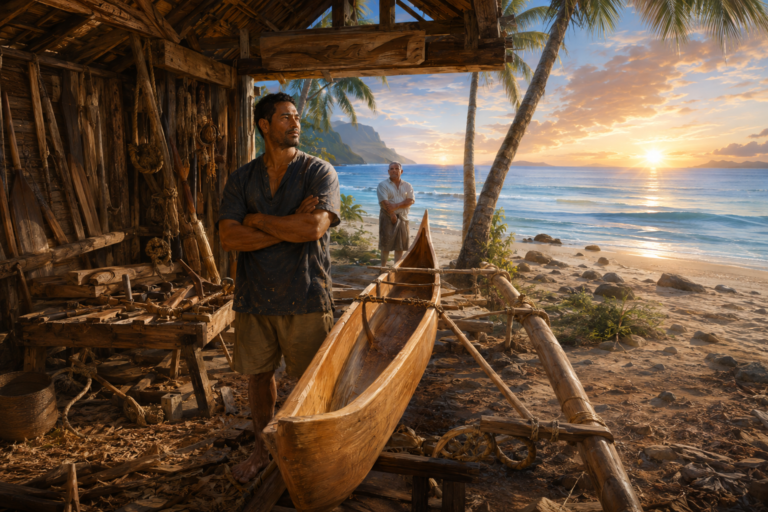
On an island surrounded by a wide blue lagoon lived a canoe builder named Matiu. He had learned the craft from his uncle Rangi, whose vessels were trusted throughout the neighboring islands. Fishermen praised their balance, wayfinders admired their clean lines, and families waited months to own one.
Above the workshop entrance hung a wooden sign carved with Rangi’s name. Matiu had worked beneath it for seventeen years.
As a boy, he swept wood shavings and sharpened tools. Later, he learned to choose trees, shape outriggers, braid lashings, and hear weaknesses hidden inside timber. Rangi taught him that every canoe must be shaped for the life it would carry.
Matiu remembered every lesson. He also noticed what his uncle sometimes missed: how a tired paddler shifted weight, where salt loosened lashings, and why a repair made far from shore must be simple.
By thirty, Matiu could build as skillfully as his uncle. He had even created an outrigger joint that could be repaired more easily at sea. Yet whenever customers praised the work, Rangi accepted their gratitude.
“Another fine canoe from your hands,” they would say.
Rangi would nod toward Matiu. “My nephew is becoming useful.”
When asked who had carved a hull, Matiu answered, “It came from Rangi’s workshop.” That was true, but not the whole truth. He had not yet learned to claim his name beside the work.
The Canoe Left on the Shore
One afternoon, a widow named Mere arrived with her two sons. Their canoe had split during a storm, and without it they could not reach the deeper water where tuna gathered.
Rangi inspected the hull. “The wood has weakened. A repair will not hold.”
After they left, Matiu looked again. The center was badly damaged, but the bow and stern remained sound. He believed he could join them around a new frame. That evening, he drew the design on a plank.
Rangi barely glanced at it. “It is too complicated.”
“It would cost less than a new canoe.”
“And take more time than the old vessel is worth.”
Matiu studied the drawing. “Mere does not need it to be worth our time. She needs it to reach the fishing grounds.”
His uncle’s expression hardened. “You have become confident.”
Matiu heard the warning beneath the words. Slowly, he rolled up the design. For weeks, it remained beneath his sleeping mat while Mere and her sons fished from the rocks.
The Question Only Matiu Could Answer
Months later, the island chief commissioned a voyaging canoe for six paddlers crossing open sea.
“I want Matiu to design it,” the chief said.
Rangi laughed. “He has never built one without my direction.”
Keeping his eyes on Matiu, the chief asked, “Will you do it?”
Excitement rose within him. For years, he had studied how a hull must lift across swells and how provisions should be balanced. Before he could answer, however, Rangi said, “He is not ready.”
The question belonged to Matiu, yet his uncle’s certainty seemed to fill the workshop.
Finally, he lowered his eyes. “Rangi should lead the work.”
For the next three months, Matiu selected the tree, shaped the hull, and designed compartments that kept provisions dry. He tested the balance repeatedly, adjusting the interior until six paddlers could move without pulling the vessel off course. At the launching, the chief praised the canoe.
Rangi smiled. “My finest yet.”
Nearly every part of the canoe bore Matiu’s hands, but none carried his name. Still, he said nothing.
When Gratitude Becomes a Cage
That night, Matiu’s friend Iosefa found him beside the empty workshop.
“I owe everything I know to my uncle,” Matiu said. “He took me in after my father died.”
“That is true,” Iosefa replied. “But gratitude should help a man stand. It should not require him to remain kneeling.”
“If I step forward, Rangi will think I am trying to replace him.”
“Are you?”
“No.”
Iosefa held his gaze. “Then why must you live as though you are?”
For the first time, Matiu wondered whether loyalty had become the name he gave his fear.
The Whole Truth
Soon afterward, the voyaging canoe returned safely from rough water. Its young captain came to request another.
“The storage compartments were your idea, were they not?” he asked Matiu.
Matiu glanced at Rangi and felt the familiar urge to soften the truth until it asked nothing of him. This time, he resisted.
“Yes. They were my design.”
After the captain left, Rangi closed the door. “You embarrassed me.”
“I answered his question.”
“You have forgotten who taught you.”
“No. I remember every day.” Matiu drew a slow breath. “I have honored you with seventeen years of work. I even allowed people to call my work yours because I feared that claiming any part of it would wound you.”
“Everything made beneath my roof belongs to this workshop.”
The answer came before Matiu could hide from it. “Then perhaps I need a roof of my own.”
“If you walk away,” Rangi warned, “do not expect to return when you fail.”
Fear moved through him. He had few tools, no customers, and no famous name. Nevertheless, he gathered his belongings the next morning.
“I am not asking permission to return,” he told Rangi. “I am saying that I must leave.”
The First Work to Carry His Name
Near the southern beach stood a neglected shelter with part of its roof missing. Matiu rented it, although each quiet day gave his doubt another voice.
Then Mere arrived with her sons.
Matiu retrieved the old design from beneath his sleeping mat. Over sixteen days, he removed the canoe’s weakened center, joined the sound pieces around a new frame, and strengthened the hull with flexible lashings. First, he tested it in the lagoon. Then he paddled beyond the reef.
It held.
Mere could not pay him fully, so she promised part of her catch. Her sons painted the canoe blue and carved a flying fish near its bow.
Soon, other villagers came. A farmer needed a narrow canoe for the river. An aging fisherman wanted a lighter outrigger, while a father requested a small vessel for teaching his daughters to paddle.
Matiu listened before drawing each design. Instead of making every customer fit one familiar answer, he let the needs of each life determine the shape of the vessel.
For each person, Matiu remembered Rangi’s finest lesson: a canoe must be shaped for the life it will carry. This time, however, the work carried Matiu’s judgment as well as his hands.
Not every attempt succeeded. His first new canoe leaked, and the rainy season ruined valuable wood. Independence did not make life easy. It made the life his.
A Name Above the Door
One evening, as Matiu carved a sign for his workshop, Rangi appeared.
“I saw Mere’s canoe beyond the reef,” his uncle said. “It is ugly.”
Matiu smiled. “Very ugly.”
“But it moves well.” Rangi examined one of the new outrigger joints. “These are not as clean as mine.”
“No.”
“But they are strong.”
After a silence, Rangi looked toward the lagoon. “When you were young, you followed every instruction. I thought that made me a fine teacher. I did not notice when teaching became keeping.”
“Nor did I notice when gratitude became permission for you to decide my worth.”
“When you left, it felt as though you were taking something from me.”
Matiu set down his carving tool. “I was taking myself with me.”
From then on, Rangi visited occasionally. He still criticized Matiu’s joints, and sometimes Matiu changed his approach. At other times, he disagreed. He no longer mistook disagreement for disrespect.
Their relationship did not return to what it had been. Instead, it became more honest: two builders sharing knowledge without asking either one to disappear.
Above the southern workshop, Matiu hung the finished sign. It bore no grand title—only his name.
Fear Does Not Hold the Paddle
Years later, the island prepared a canoe for its longest voyage in a generation. When the chief asked Matiu to lead the building, he answered before fear could borrow another voice.
“Yes.”
Matiu invited Rangi to help. Together, they argued about the hull, sail, and storage of water. Neither surrendered merely to preserve the other’s comfort. As a result, the finished canoe carried wisdom from them both.
On the morning of the launch, a young apprentice asked Matiu, “When did you know you were ready to build on your own?”
“I did not.”
The boy frowned. “Then how did you begin?”
“I realized readiness was no longer the most important question.”
“What was?”
Watching the canoe enter the water, Matiu answered, “Whether I was willing to keep abandoning myself while I waited for someone else to declare me ready.”
The wind carried the vessel toward the reef. For years, Matiu had believed personal empowerment would feel like the disappearance of fear. Instead, it felt like fear remaining—and no longer receiving the final word.
The Wisdom
Empowerment Without Erasure
Personal empowerment is often mistaken for dominance. We may imagine it as becoming the loudest person in the room or proving every doubter wrong. Genuine empowerment is quieter. It begins when we stop abandoning ourselves to remain acceptable to others.
Humility does not require erasure, and respect does not demand silence. Gratitude also does not create a lifelong debt of obedience. We can honor those who taught us without asking them to choose every season that follows.
That change can feel like betrayal, especially when belonging has depended on being agreeable. A clear “no,” an honest boundary, or a decision made without approval may awaken guilt. Yet guilt is not always evidence of wrongdoing; sometimes it is simply the feeling of leaving an old role.
Some people may resist our growth because the smaller version of us was more convenient. Others may love us deeply but struggle to understand who we are becoming. Their discomfort is not proof that our growth is wrong.
Claim Your Name Through Honest Choice
To claim your name does not require rejecting everyone who helped shape you. Advice can guide us without replacing discernment, and collaboration can strengthen our work without requiring our disappearance.
Still, no one else can grant the final permission to become ourselves. We must decide whether to walk through the open door, even when the future offers no promise of success.
The moment may not look heroic. The roof may leak, the tools may be few, and the first effort may need repair. Begin anyway.
Choice also carries responsibility. When we stop surrendering every decision, we must learn from mistakes, repair what we damage, apologize when necessary, and begin again. Personal power is not freedom from consequences. It is the willingness to meet them without handing away our voice.
Speak the whole sentence. Claim your name by honoring the work your hands have shaped. If a place requires your disappearance, give yourself permission to leave it. Then build a life sturdy enough to carry your own name.
Fear may travel beside you for part of the journey. Let it come.
Fear does not make the decision. You do.
For Further Reading:
Visit the Mayo Clinic’s Being Assertive: Reduce Stress, Communicate Better
This article explains how respectful self-expression can strengthen confidence, boundaries, and the ability to stand up for your point of view.