
COLLABORATION · 15 MIN READ
The Carpenter Who Worked Alone
In a village in northern Vietnam, where green mountains rose above fields of rice, lived a carpenter named Minh. People said his hands could persuade stubborn wood to remember what it was meant to become. He shaped doors that closed without sticking, tables that stood level on uneven floors, and cedar chests joined so tightly that even the monsoon rain could not enter them.
Minh had learned his craft from his father, who had taught him to measure twice, cut once, and never place his name upon careless work. Yet over the years, discipline hardened into something less useful. Minh began to believe that excellence required solitude.
Other craftsmen trained apprentices or called upon neighbors when a beam was too heavy to lift. Minh did neither. He swept his own workshop, sharpened his own tools, and carried more weight than was wise simply to prove that he could.
“If my name is placed upon something,” he often said, “then my hands should be the ones that built it.”
The villagers admired his skill. Some also noticed the silence that settled around him. Advice sounded like doubt to Minh. Assistance felt like intrusion. He had become so determined to need no one that he no longer recognized how often the village was already supporting him – the bamboo grower who chose his strongest poles, the blacksmith who repaired his blades, and the neighbors who brought meals when work kept him late.
Minh saw only the finished object and the name carved beneath it. He did not yet see the many hands hidden inside every lasting thing.
When the River Took the Crossing
One summer, rain fell for three days without pause. Water rushed down from the mountains, turning the river beside the village brown and powerful. It carried branches, stones, and uprooted trees through the valley. The old bamboo footbridge trembled beneath the current until its center supports broke and the crossing disappeared into the flood.
The bridge had connected the village to the road leading toward the nearest market, school, and clinic. Without it, farmers could not carry their produce across the river. Children remained home from school. Families needing medicine faced a long journey around the mountain.
When the rain eased, the elders gathered beneath the meeting house. Mud covered the riverbank, and pieces of the old bridge hung from the rocks like frayed thread.
“We must build another crossing before the next great rains arrive,” said the oldest elder. “The whole village depends upon it.”
Minh stepped forward before anyone else could speak. “I will build it.”
A bamboo grower named Bao raised his hand. “My sons and I can help choose the poles. Bamboo that grows in still air behaves differently from bamboo that has survived strong wind.”
“Bring your straightest poles to the riverbank,” Minh replied. “I will do the rest.”
A fisherman named Tuan offered several coils of rope. “I can show you the knots we use to secure boats during storms. They tighten under weight but still allow the line to move.”
“I know how to bind a bridge,” Minh said.
Then Lan, a widow whose family had maintained the old crossing for many years, stepped forward. Her late husband had spent half his life studying the river through flood and drought.
“The riverbed changed when the water rose,” she began. “Before you place the supports, you should know where the stone shelves now lie. My husband always -“
“I have studied the river,” Minh interrupted. “The village needs a carpenter, not a collection of opinions.”
The meeting house fell silent. Lan lowered her hand. The others exchanged glances, but no one challenged the man who had promised to restore their crossing.
A Bridge Made Perfect
Minh began the following morning. He selected the straightest bamboo poles and rejected any that curved. He cut every piece to an exact length, placed the supports in a clean row, and locked them together with rigid cross braces.
“A bridge must be exact,” he told the children who gathered to watch.
He measured each span twice and pulled every binding until the rope bit deeply into the bamboo. When Bao lingered nearby, Minh pretended not to notice. When Tuan left a bundle of rope beside the path, Minh used his own. Each evening, villagers brought bowls of rice, vegetables, and hot broth, then placed them upon a stone because Minh would not stop long enough to eat with them.
For twelve days, he worked from sunrise until darkness. His shoulders ached, and the skin across his palms split beneath the strain. Still, whenever someone offered assistance, he found another reason to refuse.
At last, the bridge stretched across the river in one level line. Its handrails were smooth, its bindings evenly spaced, and its supports stood in perfect rows. Minh carved his name into a small plate and fastened it near the entrance.
The villagers admired the crossing. Farmers carried baskets toward the market. Children crossed with books beneath their arms. Lan walked over it to visit her daughter on the opposite bank.
“You built it quickly,” an elder told Minh.
“And alone,” he answered.
For several weeks, the bridge remained firm. Every time Minh saw someone cross safely, he felt the quiet satisfaction of a man who believed he had proved his point.
What the Water Revealed
Then the rains returned.
At first, the river rose slowly. Minh inspected the crossing and found nothing that concerned him. The supports remained straight, the braces held firm, and every knot was as tight as the day he tied it.
During the night, however, rain pounded the mountains. By morning, the gentle river had become a wide, muscular current. Water pressed against the broad face of Minh’s bracing instead of passing freely through it. The bamboo began to groan.
Bao came running through the rain. “Loosen the side bindings,” he shouted. “Give the bridge room to move with the water.”
“If we loosen them, the structure will become unstable,” Minh replied.
“It is already carrying more force than it can bear.”
“The tight bindings are what hold it together.”
Bao pointed toward the center. “They are also preventing it from yielding.”
Before Minh could answer, the villagers heard shouting from upstream. A fallen tree rolled through the current, its torn roots reaching above the water like dark fingers.
“Clear the bridge!” Tuan cried.
The trunk struck the center supports. The bamboo bent, but the rigid frame left it nowhere to move. One binding snapped, then another. A brace split with a sound like a breaking bone. Half the bridge twisted sideways and plunged into the river.
By nightfall, little remained except broken poles and rope caught among the rocks.
Minh stood alone upon the bank. He had used fine materials. Every measurement had been correct. Every joint had been tight. Yet the bridge had lasted less than a month.
For the first time, he understood that precision could not replace wisdom – and that a structure could be flawless by one man’s measure while still being wrong for the river it needed to cross.
The Voice He Had Silenced
The next morning, Lan found Minh wading among the reeds, gathering pieces of bamboo from the shallows. The polished nameplate lay facedown in the mud.
“My husband helped build the old bridge,” she said.
Minh kept his eyes on the water. “That bridge also washed away.”
“Yes,” Lan replied. “After twenty-seven years.”
He stopped working.
Lan picked up a length of frayed rope. She explained that the old builders had anchored their supports around the strongest stones beneath the river. The poles had not stood in a perfect row because the riverbed was not perfect. Some leaned slightly upstream. Others left open channels through which rising water and debris could pass.
“The crossing looked uneven,” Minh said.
“Slightly.”
“I thought that would make it weaker.”
“No. It allowed each part to carry only the burden it was suited to hold.”
Minh looked toward the current. He remembered Lan raising her hand at the meeting house and the impatience in his own voice.
“Why did you not tell me?” he asked, though shame had already given him the answer.
“I tried.”
The words landed more heavily than blame. Minh lowered his eyes.
“I believed too many voices would weaken the work,” he said.
Lan separated the damaged rope into its smallest strands, then twisted them together again.
“One fiber breaks easily,” she said. “Many fibers, bound without crushing one another, become a cord strong enough to hold a bridge.”
Minh had spent years learning how wood carried weight. That morning, beside the ruins of his perfect bridge, he began learning how humility did the same.
The Hardest Request
That afternoon, Minh returned to the meeting house. The villagers fell silent when he entered. Some were angry. Others were simply tired. Their school, market, and clinic once again waited beyond the river.
Minh stood before them. “I can rebuild the bridge,” he said.
No one answered.
His first instinct was to defend himself – to explain the force of the tree, the unusual rain, and the soundness of his measurements. Instead, he drew a slow breath.
“But I should not rebuild it alone.”
He turned first to Lan.
“I silenced the knowledge your family carried. Will you show me what your husband understood about the river?”
Lan studied him for a moment, then nodded. “I will.”
He faced Bao.
“Will you teach us which bamboo can bend without breaking?”
“Yes,” Bao replied.
Finally, Minh turned to Tuan.
“Will you show us the knots I refused to learn?”
The fisherman smiled faintly. “I will show everyone.”
Then Minh faced the entire village.
“My skill can shape the wood,” he said. “It cannot know the river, grow the bamboo, tie every knot, feed every worker, and carry every stone. I mistook being needed for being the only one who mattered. I am sorry.”
The apology did not erase the lost weeks, but it opened a path that pride had kept closed. One by one, hands began to rise.
What Every Hand Knew
The village began again.
Lan walked the exposed riverbank and marked the stone shelves with stakes. She showed the builders where floodwater tended to turn, where debris gathered, and where the river cut deepest after heavy rain.
Bao selected bamboo that had grown on the windy slope above his grove. Some poles were slightly curved, but their fibers were dense and flexible. He taught the younger workers how to recognize a strong pole by its sound when gently struck.
Tuan demonstrated lashings that tightened beneath steady weight while allowing a small amount of movement during a sudden impact. His knots did not surrender control; they made room for the bridge to survive what no carpenter could predict.
Farmers carried stones from the terraces. Potters made clay caps to protect the cut ends of the bamboo from rain. Children sat beneath the meeting house roof and braided smaller fibers into long lengths of rope. Elders prepared meals and kept water boiling for tea. Those too frail to lift or climb repaired baskets, watched the youngest children, and told stories to keep tired workers laughing.
Minh still measured carefully and shaped every joint with skill. This time, however, he asked questions before giving instructions. He taught apprentices how to carve handrails, then allowed their hands to learn through patient correction. When a beam proved too heavy, he called for help before his back forced him to.
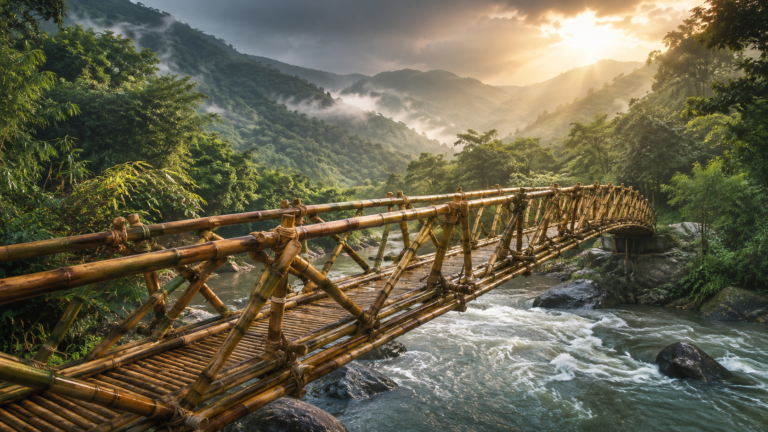
The second bridge was not as elegant as the first. Its path rose slightly near the eastern bank. Its supports stood at different angles, and several colors of rope appeared where families had contributed whatever they possessed.
Yet when a person crossed it, the bridge felt alive beneath the feet. It shifted gently. It breathed with the wind. Each piece answered the river differently, and together they carried the weight.
At the center, Minh placed a small wooden carving. It showed many hands holding one length of bamboo. Beneath it, he carved no single name.
The Bridge That Could Bend
When the next great rain came, the villagers gathered beside the river. Clouds covered the mountains, and the current rose around the new supports.
Water pushed against the bridge, but the angled poles divided its force. Open spaces allowed the flood to pass. The flexible bindings tightened, shifted, and settled again.
A heavy branch struck the center. The bridge bent.
For one long moment, Minh feared that every lesson had arrived too late. Then the ropes absorbed the strain, the bamboo lifted, and the crossing returned to its place.
Minh released a breath he had not realized he was holding.
Bao stood beside him. “You built a strong bridge,” he said.
Minh shook his head. “We built one.”
All along the bank, villagers watched water move through the supports instead of carrying them away. The bridge survived not because every piece remained rigid, but because each part was free to respond while still bound to the whole.
The following morning, the first children crossed toward school. Lan walked behind them, one hand resting upon the railing. At the center, she paused beside the carving and traced the wooden hands with her fingertips.
“He would have liked this bridge,” she told Minh.
Minh looked at the ropes, patched in many colors. “I wish I had listened sooner.”
“Then listen sooner next time,” Lan said gently. “That is how regret becomes wisdom.”
What Makes a Master
Years passed. Travelers often stopped to admire the bridge and asked Minh which master carpenter had designed it.
“The river designed part of it,” he told them. “The bamboo designed another part. The rest came from people wise enough to understand what I did not.”
The ropes were repaired many times. Thousands of hands polished the railings smooth. Whenever a section weakened, the village gathered before failure became disaster. The bridge endured because responsibility for it belonged to everyone.
When Minh eventually took an apprentice, the young man tried to complete every task without assistance. One afternoon, he struggled to lift a heavy beam onto a frame. Minh watched him attempt it three times.
“Why do you not ask for help?” Minh said.
The apprentice wiped sweat from his forehead. “I want to prove I am strong enough.”
“Strong enough for what?”
“To become a master.”
Minh called two workers from the neighboring shop. Together, the four men lifted the beam easily into place.
“A master is not the person who can carry every beam alone,” Minh said. “A master knows which beams should never be carried that way.”
The apprentice looked toward the bamboo bridge crossing the river below. Its supports were irregular. Its ropes were patched. No single name claimed it.
Yet it still stood – not because one man had made it perfect, but because many people had made it resilient.
Minh rested one hand upon the newly placed beam. He had once believed that asking for help would make his work less his own. Now he understood that the finest thing he had ever helped build carried no signature at all.
It carried a village.
The Wisdom
The Strength and Shadow of Self-Reliance
Self-reliance can be a virtue. It teaches discipline, responsibility, and the confidence to act without waiting for someone else to rescue us. There are seasons when we must trust our own hands and continue even when no one walks beside us.
Yet a strength used without wisdom can become a wall. Self-reliance hardens into isolation when we begin to believe that accepting help diminishes our accomplishments, that uncertainty is shameful, or that another person’s contribution makes the work less truly ours.
Pride often disguises itself as independence. It tells us that strength means carrying every burden alone, knowing every answer, and never allowing anyone to see where we are uncertain. Because this voice sounds disciplined, we may not recognize the fear beneath it: the fear of being corrected, indebted, vulnerable, or ordinary.
Minh’s ability was real. His mistake was not that he trusted his craft, but that he treated craft as the only knowledge the bridge required. Healthy self-reliance helps us bring our strength to the work. Humility helps us remember that our strength is only one part of what the work may need.
Every Person Knows Part of the River
Wisdom is often distributed. One person understands the riverbed. Another knows which bamboo has survived strong wind. Someone else knows the knot that can hold without becoming rigid. Even the children can braid fibers that no single hand could stretch far enough alone.
We lose more than goodwill when we dismiss another person’s voice. We may lose the part of reality they can see from where they stand. Experience, culture, age, grief, labor, and love all teach different lessons. No single viewpoint contains the whole river.
Listening does not require surrendering judgment. Minh still had to measure, shape, and decide. Collaboration did not erase his responsibility; it made his decisions more informed. The goal was not to collect every opinion without discernment. It was to make room for knowledge that pride had taught him to overlook.
A wise community does not ask everyone to become the same. It allows each person to offer what they have learned, then binds those contributions around a shared purpose.
Resilience Is Not Rigidity
A rigid structure may look impressive in calm weather. Its true limitations appear when the waters rise.
Minh’s first bridge failed partly because every piece had been forced into one perfect arrangement. Nothing could shift, absorb strain, or respond to what he had not predicted. The second bridge survived because its strength included flexibility.
Our lives and communities often work the same way. Resilience is not the refusal to bend. It is the ability to adapt without losing connection to what holds us together. A family may change roles during illness. A business may revise a cherished plan. A leader may admit that new information requires a different path.
Flexibility is not weakness when it serves what matters. Sometimes bending is how we keep from breaking. Sometimes adjusting the plan is how we remain faithful to the purpose.
Asking for Help Is a Form of Wisdom
For Minh, the hardest task was not shaping bamboo or standing in floodwater. It was returning to the meeting house and saying, in front of everyone, that he should not rebuild alone.
Asking for help can feel like an admission of failure, especially for those who have survived by becoming capable. Yet there is no shame in saying: Show me. Stand beside me. Help me carry this.
Those words do not erase our strength. They direct it toward a better outcome. They also give others permission to contribute, belong, and be known for the gifts they carry.
Real accountability requires more than quietly changing course. Minh named the harm he had caused, apologized to those he had dismissed, and asked them to participate without demanding that they trust him immediately. Humility became visible through action.
We do not become smaller when we receive what another person can offer. Often, our strength finally becomes wise.
For Further Reading:
For further reading, explore the University of Kansas Community Tool Box’s Creating and Maintaining Coalitions and Partnerships to discover how trust, shared responsibility, and cooperation allow communities to accomplish what no individual can achieve alone.