
What Gathers in Silence
SELF-WORTH· 13 MIN READ
The Question That Followed Him
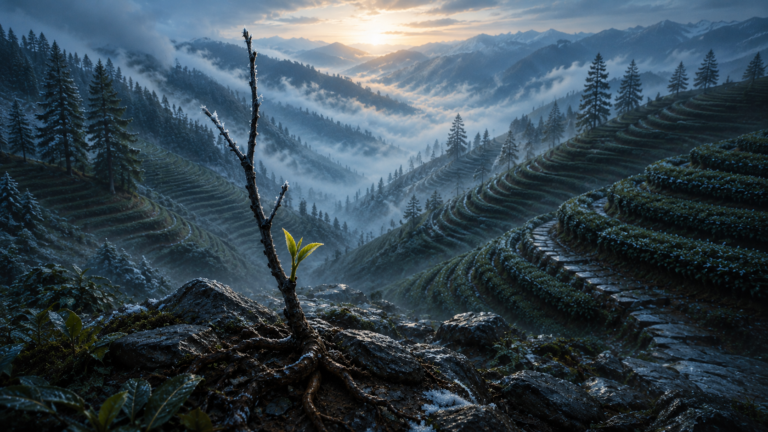
High on a mist-covered mountain, where narrow stone paths wound between terraces of green, lived an old woman who grew tea. Her garden had belonged to her family for generations. The oldest bushes clung to the steepest slopes, their roots reaching deep among rocks polished by centuries of rain. Each spring, they offered tender leaves scented with orchids and distant pine.
People traveled from many villages to buy the old woman’s tea. They praised its clarity, its warmth, and the quiet sweetness that lingered long after the cup was empty. Even so, she accepted their praise with only a small smile.
“The mountain makes the tea,” she would say. “I merely learn when not to interfere.”
Among those who worked beside her was a young apprentice named Yìchén. He was clever, attentive, and willing to work from before sunrise until the last basket had been carried inside. Each morning, he swept the stone courtyard, brought water from the spring, and watched as the old woman examined every leaf.
Yìchén wanted to become a great tea grower. More than that, however, he wanted to become one quickly. He did not yet understand how tightly he had tied his self-worth to visible progress—or how much the mountain would teach him about self-worth and patience.
“Honored Teacher,” he asked one morning, “how long will it take before I can grow tea like yours?”
The old woman looked across the terraces, where mist rested softly between the rows.
“Long enough,” she replied.
Yìchén waited for the rest of the answer. None came.
When the Mountain Went Quiet
During his first spring, Yìchén learned to gather the newest leaves without bruising them. Then, in summer, he learned to shape and dry them over gentle heat. By autumn, he was carrying baskets of compost up the steep paths and spreading it beneath every bush. At last, winter arrived.
A bitter wind descended from the northern peaks. Frost silvered the terraces, while snow covered the highest garden. Soon, the tea bushes stopped growing. Their leaves darkened, their branches became still, and for many weeks the mountain offered nothing to harvest.
At first, Yìchén told himself the pause was temporary. Nevertheless, each morning he walked among the silent rows searching for new leaves. Each morning, he found none.
“How long will the garden remain like this?” he finally asked.
“Until it is ready to awaken,” said the old woman.
“But we are doing nothing.”
“We are waiting.”
Yìchén frowned. Waiting did not feel like work. There were no baskets to fill, no leaves to shape, and no customers climbing the mountain path. Consequently, each quiet day felt wasted. Worse, he felt wasted with it.
Forcing an Early Spring
One afternoon, Yìchén noticed a small tea bush growing beside the wall of his cottage. It had been planted the year before but had produced only a handful of leaves. Unlike the old bushes, it looked fragile and uncertain. Therefore, he decided he would not allow it to sleep through the winter.
First, he gathered dry reeds and built a shelter around it. At night, he placed warm stones near its roots. During the day, he carried water from the spring and poured it over the soil. Still, the bush did not grow.
So Yìchén brought more water. He loosened the earth, added rich compost, and covered the branches with cloth to shield them from the wind. After a week, however, nothing had changed.
“The plant is stubborn,” he told the old woman.
“Perhaps,” she said.
“Or perhaps it needs more care.”
“Perhaps it needs less.”
Yìchén did not believe her. He had always been taught that effort brought results. If a little care was good, then surely more care had to be better. Accordingly, he warmed the soil each morning, watered the bush twice a day, and trimmed its smallest branches so it could save its strength.
Eventually, tiny green buds appeared.
Yìchén ran to find the old woman. “Come and see! My tea bush is waking before all the others.”
She followed him to the cottage wall and studied the new growth. Yet she did not smile.
“You have persuaded it that spring has arrived,” she said.
“Then I have succeeded.”
“Have you?”
Yìchén looked at the delicate buds. “What else could it mean?”
“It means the plant believed the warmth you gave it. Now it must answer a season that has not truly changed.”
That night, the sky cleared. Without clouds to hold the day’s warmth, the temperature fell sharply. Frost slipped through a gap in the reeds and settled over the tender buds. By morning, every one of them had turned black.
Yìchén removed the cloth and stared. The new growth crumbled beneath his fingers. Meanwhile, across the old terraces, the other bushes remained dark and still; however, the leaves they had kept were untouched by frost.
“I was trying to help,” he said.
“I know,” the old woman replied.
“Why did it grow if it was not ready?”
“Because you made it believe the danger had passed.”
The Hard Work of Restraint
Yìchén lowered his eyes. “Will it survive?”
“I do not know.”
Together, they removed the shelter. Then the old woman knelt and placed one hand upon the cold earth.
“What should we do now?” Yìchén asked.
“Nothing.”
“But the buds are dead.”
“Yes.”
“And the branches may be damaged.”
“Yes.”
“Then surely we must do something.”
The old woman stood. “We will give the plant what the season is asking of us.”
“And what is that?”
“Restraint.”
Yìchén disliked the word. To him, restraint sounded too much like surrender. Even so, he obeyed.
As the weeks passed, snow gathered along the terrace walls and wind moved through the bare branches. The mountain seemed empty of life. In the meantime, the old woman repaired baskets, sharpened tools, and sorted the previous year’s tea.
Each afternoon, she prepared a small pot. She warmed the clay vessel, measured the leaves, and poured water over them. Then she sat beside the window while the tea opened in its own time. Yìchén often joined her, although he found her quietness difficult.
One day he asked, “How can you sit so peacefully when the garden is producing nothing?”
The old woman poured tea into two cups. “Who told you it is producing nothing?”
Yìchén gestured toward the frozen terraces. “There are no new leaves.”
“New leaves are not the only form of growth.”
“Then what else is growing?”
“The roots.”
He looked toward the garden. “But we cannot see them.”
“No.”
“So how do you know?”
“Because spring has returned before.”
Self-Worth and Patience Beneath the Surface
Yìchén lifted his cup but did not drink. “What if spring does not return this time?”
The old woman considered the question. “Then our worry will not bring it.”
She raised the cup and breathed in its fragrance. “The tea bush does not spend winter pulling on its own branches, demanding that leaves appear. Instead, it gathers itself below the earth. What looks like stillness from above may be preparation underneath.”
Yìchén looked down at the pale gold tea. He understood her words, but he did not yet trust them. After all, how could something be growing if no one could see the proof? And if he was not producing, improving, or impressing his teacher, how could he know he was becoming worthy of the life he wanted?
For the first time, however, he wondered whether that was the wrong question. Perhaps self-worth and patience belonged to the same lesson. Perhaps he did not have to force visible results in order for his time, his work, or his life to matter.
A Tempting Shortcut
Near the end of winter, a merchant arrived from the city. He wore a fine wool coat and carried a ledger filled with orders from wealthy households.
“I have heard that the first spring tea from this mountain is finer than any other,” he told the old woman. “I will pay twice the usual price if you deliver it before the growers in the southern valley.”
“The mountain will decide when the leaves are ready,” she replied.
The merchant laughed. “Mountains do not conduct business.”
“This one does.”
He opened his ledger and showed her what he was prepared to pay. “With this money, you could repair the eastern terraces, hire more workers, and build a better road. All you have to do is bring the harvest forward by two weeks.”
Yìchén stared at the figure. It was more money than the garden had earned in several seasons. Immediately, he remembered the warm stones and reed shelter beside his cottage.
“We could cover part of the lower garden,” he said. “The valley growers warm their plants to bring the leaves sooner. I have seen it done.”
The merchant nodded. “Your apprentice understands opportunity.”
The old woman closed the ledger. “Opportunity that asks the leaf to become ready before it has gathered its strength is only impatience dressed in silk.”
The merchant’s expression hardened. “Another grower will accept my offer.”
“Then you should buy his tea.”
He left before sunset. Afterward, Yìchén watched him descend the mountain path.
“Were you not tempted?” he asked.
“Of course.”
“You did not look tempted.”
“Wisdom is not the absence of temptation,” she said. “It is knowing which hunger should not be fed.”
What Patience Really Costs
That evening, Yìchén returned to the small bush beside his cottage. The blackened buds still clung to its branches. He wanted to dig around the roots and search for some sign of life. Instead, he placed his palm on the earth, just as the old woman had done.
The soil was cold. It told him nothing.
In that moment, Yìchén finally understood that patience was not peaceful simply because people spoke of it gently. Sometimes, patience was deeply uncomfortable. It could mean standing beside something beloved without being able to rescue it. It could mean allowing silence to remain silent. Above all, it could mean resisting the urge to disturb the roots merely to prove they were alive.
So Yìchén waited—not because he had stopped caring, but because he was learning a wiser way to care.
When Spring Finally Came
The first sign of spring did not appear in the tea garden. Instead, it came as water. Snow melted along the stones and filled the narrow channels between the terraces. The mountain spring grew louder, birds returned to the cedar trees, and the air carried the faint scent of wet earth. Still, the tea bushes did not open.
Each morning, Yìchén walked among them.
“Not yet,” said the old woman.
Several warm days followed. Small plants emerged beside the path, while plum blossoms opened in the village below. Soon, the merchant’s growers in the southern valley began sending their early tea to market. Nevertheless, the old woman did not harvest.
When Yìchén heard the first leaves were bringing a great price, his worry returned. “Are we waiting too long?”
In response, the old woman handed him a leaf from one of the oldest bushes. “Chew it.”
Yìchén tasted the leaf. It was sharp and thin, with a bitterness that vanished almost immediately.
“Now you know,” she said.
Another week passed. Gradually, the buds grew fuller. Their green deepened, and a fine silver down appeared upon the youngest leaves. Once again, the old woman handed Yìchén one to taste.
This time, the bitterness opened into sweetness. A cool fragrance rose behind it, subtle but unmistakable.
Yìchén’s eyes widened. “The leaf has changed.”
“It has finished gathering what winter gave it.”
The following morning, the old woman rang the bronze bell in the courtyard. Workers climbed the terraces with empty baskets, and families from the village joined them among the rows. Finally, as the rising sun burned away the mist, the harvest began.
The Leaf He Did Not Pick
Yìchén gathered each tender bud with a reverence he had not possessed the year before. He no longer saw only a leaf. Instead, he saw the cold rain it had endured, the nourishment drawn through hidden roots, and the long silence in which its character had formed.
By midday, he reached the small bush beside his cottage. Its branches still looked damaged. The blackened buds had fallen away, leaving empty places along the stems. Yet close to the base of one branch, a single green shoot had appeared.
It was smaller than the new growth elsewhere in the garden, but it was alive. Yìchén called for the old woman, and she came to examine it.
“It survived,” he said.
“Yes.”
“Will it grow as it would have if I had left it alone?”
“No one can know the shape of a season that did not happen.”
Yìchén touched the new leaf gently. “I nearly destroyed it because I wanted to see it grow.”
“You wanted proof that your care was working.”
He looked at her. “Was that wrong?”
“Wanting proof is human. Demanding it before its time is where harm may begin.”
For that reason, they left the little shoot on the branch. Yìchén did not harvest it.
A Flavor That Could Not Be Rushed
After the mountain leaves had been dried, the old woman prepared tea from the first picking. Its fragrance filled the room before she poured it. The color was clear and luminous. Although the first taste was gentle, its sweetness deepened with every breath. Yìchén had never tasted anything like it.
“The merchant’s tea reached the city before ours,” he said.
“It did.”
“And he earned twice the price.”
“Perhaps.”
“Then what did our waiting give us?”
Instead of answering, the old woman poured more water over the leaves. The second infusion was richer than the first.
“Drink again.”
Yìchén lifted the cup. The warmth moved through him slowly. Beneath the sweetness, he tasted rain, stone, and something he could not name—the quiet strength of a plant that had not been hurried through winter.
“Our tea carries the mountain,” he whispered.
At last, the old woman smiled. “Now you understand.”
The Answer Becomes His Own
Years passed, and Yìchén became a skilled grower. In time, he learned to recognize the changing scent of the soil, the approach of frost, and the exact morning when a leaf had gathered enough of the season to be picked. Eventually, people came to study with him, just as he had once studied beside the old woman.
Among them was a young apprentice who worked hard, asked many questions, and hated to wait. One winter morning, she found Yìchén sitting beside a dormant tea bush.
“What are you doing?” she asked.
“Watching the garden grow.”
The apprentice looked across the silent terraces. “Nothing is growing.”
Yìchén remembered the warm stones, the blackened buds, and the cold earth beneath his impatient hands. Then he smiled.
“The most important growth does not always announce itself.”
“But how long must we wait?”
“Long enough.”
The apprentice frowned, just as he once had. Therefore, Yìchén poured tea into two cups and invited her to sit beside him. Below them, mist moved through the valley. Above them, the mountain stood quiet beneath the winter sky.
Deep within the earth, roots reached among the stones. They did not ask to be seen, nor did they mistake silence for abandonment. Instead, they gathered what they would need for a spring that had not yet arrived.
The Wisdom
When Progress Goes Quiet
We live in a world that praises visible progress. We are encouraged to produce, achieve, announce, and prove that our effort is leading somewhere. Therefore, when results do not appear quickly, we may assume nothing is happening—or, worse, that we have fallen behind.
Yet not every season is meant for harvest. Some seasons deepen the roots from which the next chapter will grow. Healing may be taking place before strength can be felt. Wisdom may be forming before words can express it. Likewise, a dream may be gathering substance while the surface of life appears unchanged.
Self-Worth Is Not a Harvest
Like Yìchén, we may connect our self-worth to what we can point to, complete, or prove. If nothing new is visible, we may believe we are failing. However, self-worth and patience ask us to consider another possibility: perhaps our value is not measured by how quickly we bloom.
You do not become worthy only when the result appears. You are not more deserving of rest, compassion, or belonging because you reached spring before someone else. In fact, comparing seasons often makes us force what needs time. Growth has its own rhythm, and worth does not rise or fall with the harvest.
Patience Is an Active Form of Care
Patience is not passive resignation. On the contrary, it asks something demanding of us: to remain faithful without forcing, to offer care without controlling the outcome, and to resist digging up what we planted merely to check whether it has begun.
Of course, there are times when effort is necessary. There are also times, however, when greater effort becomes interference. Wisdom is learning the difference. Sometimes the next right action is to water. At other times, it is to stop watering, step back, and trust the roots.
Do Not Manufacture an Early Spring
Because uncertainty is uncomfortable, we may try to create an early spring in our own lives. We pressure ourselves to recover, decide, succeed, forgive, or begin again before the deeper parts of us are ready. As a result, tender growth may appear before it has the strength to survive the frost that remains.
We are not machines designed to produce the same result in every season. Instead, we are living beings shaped by cycles of action and rest, fullness and emptiness, emergence and retreat. Consequently, a quiet season is not necessarily a wasted one. The unseen work may be the very thing that gives our future growth its character, depth, and sweetness.
Trust What Is Still Becoming
So do not curse the branch because it has no leaves. Do not disturb the roots simply because you cannot see them. And do not confuse a pause with abandonment. Self-worth and patience both deepen when we stop demanding constant proof that our lives are moving forward.
Spring does not need to be dragged up the mountain. When its hour comes, what has gathered strength in silence will know how to rise.
For Further Readings:
To explore the quiet strength at the heart of What Gathers in Silence, read Greater Good’s How Patience Can Help You Find Your Purpose, which examines how patience can support resilience, self-discipline, and personal growth. Then visit Dr. Kristin Neff’s What Is Self-Compassion? to discover how self-kindness can nurture a steadier sense of self-worth that is not dependent on visible achievement.