
The Beauty of What Remains
A STORY OF RESILIENCE & REBUILDING · 5 MIN READ
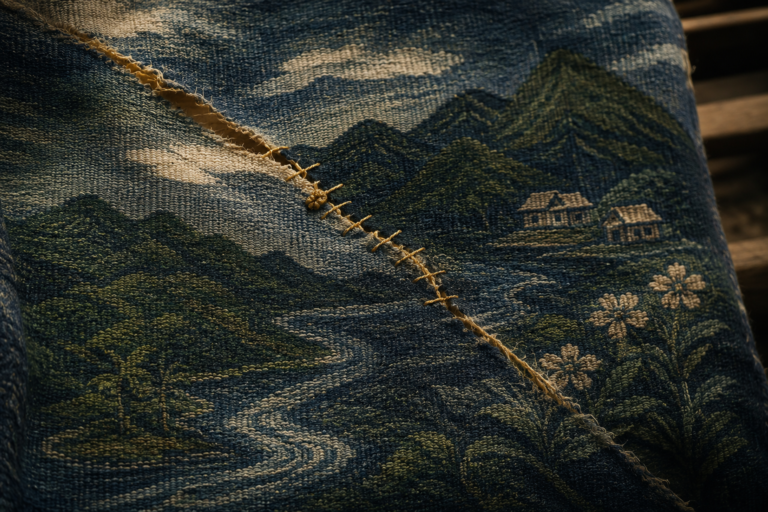
The Pattern Amara Planned
Amara lived on an island in the northern Philippines, where green mountains descended toward a restless sea. To her, beauty came from order: a steady hand, an even line, and a pattern followed without deviation.
Her grandmother taught her to prepare the thread, while her mother taught her to stretch it upon the loom. From them, Amara learned that patience and tension could bind separate strands into cloth strong enough to endure. She believed the same was true of life—if every thread remained in its proper place, the pattern would hold.
A Weaver Known for Precision
Amara became known for precise patterns. Her mountains rose evenly, her rivers never wandered, and people said her hands never made mistakes.
Eventually, she dreamed of weaving one great cloth about her island. It would hold mountains, rice terraces, boats, rain flowers, and a golden sun. Before she touched the loom, she drew every line.
Her daughter, Lira, worked differently. Instead of following drawings, she tied leftover colors together. Then she wove crooked houses, red clouds, and blue fish with golden tails.
“You must know what you are making before you begin,” Amara told her.
“Sometimes I discover it while I am weaving,” Lira replied.
When the Earthquake Changed Everything
At the start of the dry season, Amara began her great cloth. First, dark mountains rose beneath her hands. Next came silver streams, village roofs, and tiny white flowers. Visitors saw an island appearing. Amara, however, saw only the empty center awaiting its golden sun.
A Tear Through the Center
Six months later, an earthquake struck. The floor rolled like a boat’s deck. Roof tiles shattered, dogs barked, and the meeting-house bell rang by itself.
When the shaking stopped, Amara rushed into her damaged workshop. The loom still stood, but an upper beam had cracked. Hundreds of threads had pulled sideways. As a result, a deep diagonal tear crossed the mountains and the empty place meant for the sun. The river twisted. Houses leaned. Six months of perfect work had broken in moments.
“The cloth is ruined,” Amara whispered.
Lira studied the tear. “Perhaps we can add new thread.”
“The pattern no longer meets.”
Afterward, Amara folded the cloth and hid it in a chest. For weeks, she did not weave. Meanwhile, the village repaired roofs, cleared stones, and shared food with families who had less.
Resilience and Rebuilding Begin with One Thread
One afternoon, Lira spread the cloth beneath a mango tree. Then she laid strands of red, gold, black, and white across the opening.
“Those colors do not belong there,” Amara said.
“The sun you planned cannot fit anymore,” Lira answered. “But something else might.”
Amara’s voice hardened. “This cloth was meant to preserve what we were.”
Lira looked toward the scar on the mountain. “But that is not all we are now.”
After Lira left, Amara unfolded the entire cloth. Around the tear remained months of beautiful work. The mountains still rose. Boats still crossed the indigo sea. Flowers still opened among the houses. Yet the drawing beside it showed an island untouched by what had happened. The cloth, on the other hand, told the truth.
That evening, Amara watched neighbors raise a roof. Nearby, children turned a broken door into a boat. An old man joined two cracked beams with a pale brace.
“Does it trouble you that the repair can be seen?” Amara asked.
“No,” he said. “It reminds us where the house needed help.”
The Knots That Held the Village Together
The next morning, Amara rebuilt her loom. When Lira appeared in the doorway, Amara held up a strand of gold.
“Are you going to finish it?” Lira asked.
“I know only the next line.”
Together, they secured each loose thread where it rested. Lira tied new colors to ends too short to reconnect. At first, Amara tried to hide the knots. However, the cloth grew stiff beneath her hands.
“Let them remain,” Lira said. “They are holding the pieces together.”
Therefore, they stopped disguising the repair. Across the broken center, they wove an open circle of gold. Red and orange threads traveled from it like light. Black marked the fearful night after the earthquake. White knots honored the homes that had sheltered neighbors. Green represented the food families had shared.
Soon, the work belonged to the village. The carpenter brought timber-colored thread. The midwife offered crimson fiber, while fishermen brought cord from repaired nets. Even the children chose bright scraps.
Because many hands joined the work, every strand carried two truths: what had happened and how the village had answered it.
The Beauty of What Remains
Months later, Amara hung the cloth in the meeting house. It was not symmetrical. The river changed direction, knots rose above the surface, and dark lines crossed the gold. Nevertheless, the open sun appeared alive. Its light reached toward houses, rivers, and repaired nets.
An elderly woman stepped closer. “I can see where the tear began,” she said, “but I cannot see where it ends.”
Amara followed the new threads as they traveled through the cloth. “Neither can I.”
From then on, the weaving remained in the meeting house. Before it, villagers celebrated, said farewell, made decisions, and remembered how many hands had helped them rebuild.
Years later, Lira asked whether her mother wished the cloth had never been torn.
Amara touched one of the visible knots. “I wish the earthquake had never harmed our village. But I no longer wish the cloth would pretend it never happened.”
Outside, evening settled over changed mountains. The village was not the one Amara had planned to weave. Still, it was alive, connected, and becoming.
The pattern had broken. The story had not. Instead, it had asked for new hands, new colors, and the courage to weave what was true.
The Wisdom
Rebuilding Without Erasing the Past
Life does not always unfold according to the pattern we plan. We may have a clear picture of the work we will do, the people who will remain, and the milestones we expect to reach. Then illness, loss, disappointment, or circumstances beyond our control can change the design entirely.
When this happens, it is natural to grieve the life we thought we would have. Acceptance does not require us to call the hardship beautiful or to find an easy explanation for everything we have lost.
Resilience and rebuilding are not about pretending that nothing happened or forcing life to look exactly as it did before. They mean accepting what has changed, caring for what remains, and taking the next step even when the entire path is not yet clear.
The visible knots in Amara’s cloth represent the places where help was needed and received. The threads contributed by the villagers remind us that rebuilding is rarely done alone. The love, strength, and wisdom of others often become part of the new pattern taking shape.
A life changed by hardship may look different from the one we imagined, but it can still hold beauty, purpose, and meaning. The hardship itself does not become good simply because we survived it. However, it does not have to have the final word. We can honor what was lost, accept what has changed, and create something meaningful from what remains.
For Further Reading:
Explore more Stories for the Journey for reflections on courage, resilience, faith, and renewal. For practical guidance, read the American Psychological Association’s resource on building resilience.